Single-mode fiber is the core medium for long-distance, high-bandwidth data transmission and is widely used in global telecommunications networks. Currently, the mainstream single-mode fibers on the market mainly fall into three categories. Let's learn more about them with the professional team at Skywardcable.
Single-mode fiber is the core medium for long-distance, high-bandwidth data transmission and is widely used in global telecommunications networks. Currently, the mainstream single-mode fibers on the market mainly fall into three categories. Let's learn more about them with the professional team at Skywardcable.
Detailed Explanation of Mainstream Single-Mode Fibers
G.652D Standard Single-Mode Fiber
Core size: 8-10µm
Main working wavelength: 1310nm & 1550nm
Product advantages: Low signal attenuation, stable chromatic dispersion, excellent comprehensive transmission performance
Usage scenarios: Ideal choice for backbone communication networks, metropolitan area networks and all kinds of long-distance communication trunk lines
Industry highlight: Classic general-purpose fiber, balanced cost and performance, large-scale stable supply
G.657A1 Low Bending Loss Optical Fiber
Core size: 8-10µm
Minimum bending radius: 10mm
Compatibility: 100% fully compatible with G.652D fiber
Product advantages: Greatly enhanced bending resistance, not easy to cause signal loss after bending
Usage scenarios: Mainly used for FTTH fiber to the home engineering and indoor wiring layout
G.657A2 Ultra Low Bending Loss Optical Fiber
Core size: 8-10µm
Minimum bending radius: 7.5mm
Compatibility: Fully compatible with mainstream G.652D fiber
Product advantages: Top-level anti-bending performance, better flexibility than G.657A1
Usage scenarios: High-density wiring space, narrow pipeline and various difficult wiring construction environments
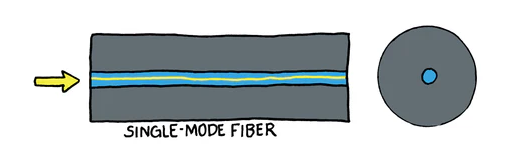
How to Choose the Right Single-Mode Fiber for Your Project
Multimode fiber features a large core diameter, simple splicing process, and low deployment cost, making it an ideal choice for short-distance, high-density network applications. It is primarily used in short-distance transmission scenarios such as data center cabling, LAN construction, and enterprise office networks. Depending on the bandwidth and transmission performance, each OM series fiber has its own specific market positioning and application area.
When purchasing fiber optic cables for communication, you can choose the appropriate model based on your actual construction needs. For long-distance outdoor trunk transmission projects, G.652D is the most cost-effective choice. For home access and regular indoor cabling projects, G.657A1 can meet daily construction needs. If you are facing a laying environment with limited space, dense cabling, and frequent bends, G.657A2 ultra-bend-resistant fiber optic cable is the most reliable solution.
Skywardcable's full range of single-mode fiber optic cables strictly adheres to international industry standards, ensuring stable quality, a complete range of specifications, ample inventory, global shipping support, and customized services.


