Quick connectors and fiber optic adapters are both common passive optical components used for fiber connections, but they are often confused due to similar functions. In fact, they differ in functional role, structural design, and application scenarios. This article clarifies these differences to help professionals choose the most cost-effective solution.
Basic Overview of Two Optical Fiber Components
Quick connectors, also called field-assembled fiber optic connectors, are reusable and detachable passive optical devices widely used in fiber optic connection projects. They are mainly classified into mechanical connection type and fusion type, and typically consist of a main body, outer shell, and end cap, used for direct fiber-to-equipment connections.
Fiber optic adaptors are essential passive devices in cabling systems, designed to connect two fiber connectors with the same or different interfaces. They are widely used for patch cord connections and linking patch cords to optical equipment. Commonly applied in TV networks, LANs, fiber communication systems, and FTTH, adaptors are classified into flanged and non-flanged types: non-flanged adaptors clip directly onto panels or trays, while flanged adaptors require screw fixing for more stable installation.
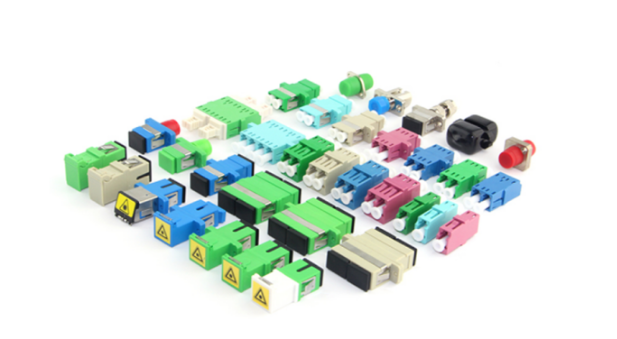
Key Differences Between Fast Connector and Fiber Optical Adaptor
Interface Type: Fast connectors use a single fixed interface (e.g., SC, LC) and only connect one specific fiber/equipment type. Fiber optic adaptors support multiple interface types (FC, SC, ST, LC, MPO, etc.), enabling conversion and connection between different connector standards.
Core Function: Fast connectors directly terminate fiber and create a transmission link. Fiber optic adaptors mainly serve as coupling devices, allowing different connectors or equipment interfaces to be connected.
Appearance & Structure: Fast connectors are usually plastic, with an elongated block shape and a single connector type. Fiber optic adaptors are made of metal or plastic, typically rectangular or cylindrical, with ports on both ends to match different connectors.
Application Scenarios: Fast connectors are used for direct fiber-to-terminal connections in LAN/WAN/data center cabling. Adaptors are mainly installed in distribution frames, switches, and other intermediate equipment for cross-connection.
Pluggability: Fast connectors are detachable and reusable, making maintenance easier. Adaptors are usually fixed after installation and are not designed for frequent plugging/unplugging.


