Currently, OM series multimode fiber is one of the most widely used fiber types in the industry. This article systematically analyzes five mainstream fiber types: OM1, OM2, OM3, OM4, and OM5, clarifying their performance differences and applicable scenarios. The aim is to help procurement personnel, engineers, and project contractors make cost-effective fiber selection decisions. Let's discuss this together with the professional team at Skywardcable.
Currently, OM series multimode fiber is one of the most widely used fiber types in the industry. This article systematically analyzes five mainstream fiber types: OM1, OM2, OM3, OM4, and OM5, clarifying their performance differences and applicable scenarios. The aim is to help procurement personnel, engineers, and project contractors make cost-effective fiber selection decisions. Let's discuss this together with the professional team at Skywardcable.
Advantages of Multimode Fiber
Multimode fiber features a large core diameter, simple splicing process, and low deployment cost, making it an ideal choice for short-distance, high-density network applications. It is primarily used in short-distance transmission scenarios such as data center cabling, LAN construction, and enterprise office networks. Depending on the bandwidth and transmission performance, each OM series fiber has its own specific market positioning and application area.
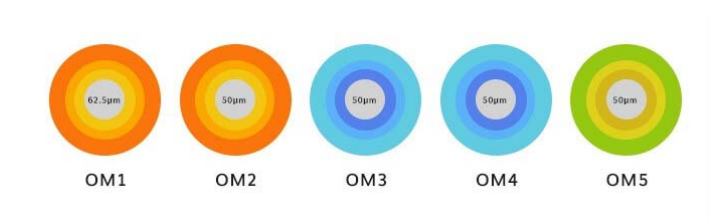
Performance & Application Analysis of Each OM Series Fiber
OM1 Fiber
Core Diameter: 62.5 µm
Bandwidth: 200 MHz•km @ 850 nm
Max Transmission Distance: 300 meters (100 Mbps)
Application Scenarios: Primarily for legacy network systems and low-speed local area networks.
Product Advantages & Limitations: With mature manufacturing technology and low cost, OM1 is suitable for old equipment renovation projects. Nevertheless, its limited bandwidth and short transmission distance make it incompatible with modern high-speed network construction.
Core Diameter: 50 µm
Bandwidth: 500 MHz•km @ 850 nm
Max Transmission Distance: 550 meters (1 Gbps)
Application Scenarios: Medium-speed enterprise networks and small-scale campus & factory network layouts.
Product Advantages & Limitations: Optimized based on OM1, it boasts higher bandwidth and longer transmission distance. It is a cost-effective choice for small and medium-sized enterprises with low bandwidth demands.
Core Diameter: 50 µm
Bandwidth: 2,000 MHz•km @ 850 nm
Max Transmission Distance: 300 meters (10 Gbps)
Application Scenarios: 10 Gbps Ethernet deployment, matching VCSEL laser transmission technology.
Product Advantages & Limitations: It is a mainstream high-speed multimode fiber for conventional data centers, featuring stable high-speed transmission performance and strong compatibility with mainstream communication equipment.
Core Diameter: 50 µm
Bandwidth: 4,700 MHz•km @ 850 nm
Max Transmission Distance: 550 meters (10 Gbps)
Application Scenarios: Advanced large-scale data centers, high-bandwidth cloud computing and server interconnection projects.
Product Advantages & Limitations: It has ultra-high bandwidth, realizing long-distance stable transmission under 10 Gbps high-speed conditions, effectively meeting the continuous bandwidth growth demand of modern data centers.
Core Diameter: 50 µm
Bandwidth: Consistent with OM4, supporting 850-950 nm wide wavelength range
Max Transmission Distance: Equivalent to OM4
Application Scenarios: Shortwave Wavelength Division Multiplexing (SWDM) system, supporting 40 Gbps and 100 Gbps high-speed transmission.
Product Advantages & Limitations: A new-generation multimode fiber tailored for emerging high-speed communication technologies. The wide wavelength coverage improves spectrum utilization and is the preferred fiber for future upgraded data centers.


