When setting up or upgrading a network—whether for a home or a business—a common question invariably arises: Should you choose UTP or STP patch cables? Gaining a deep understanding of the subtle differences between these two cable types is the key to making an informed decision. In this guide, we will demystify Unshielded Twisted Pair (UTP) and Shielded Twisted Pair (STP) cables, outline their ideal use cases, and help you determine which type best meets your specific networking requirements.
When selecting
network cables, a common question invariably arises: Should you choose UTP or STP cables? A thorough understanding of the subtle distinctions between these two cable types is the key to making an informed decision. In this guide, we will demystify Unshielded Twisted Pair (UTP) and Shielded Twisted Pair (STP) cables, outline their ideal application scenarios, and help you determine which type best meets your specific networking requirements.
Decoding UTP
The Standard Choice for Most Networks
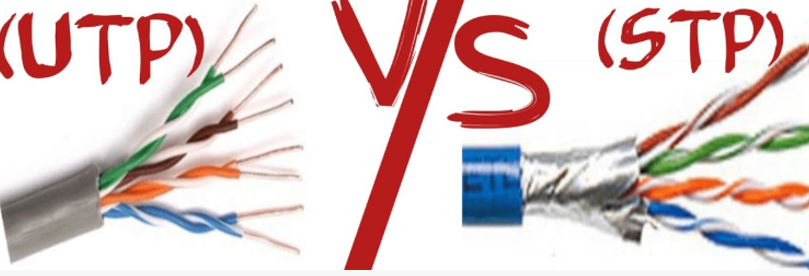
UTP, an acronym for Unshielded Twisted Pair, is the most widely used cable type in a vast array of modern networking environments. UTP cables consist of simple copper wires twisted together (typically in four pairs) and encased within a protective outer jacket; notably, UTP cables contain no additional internal shielding layers. Instead, they rely primarily on the twisted structure of the copper pairs themselves, along with the material of the outer jacket, to minimize signal interference and resist physical damage.
In everyday life, UTP cables are ubiquitous: they are the very cables used for telephone lines and standard network cabinet cabling. They are characterized by being slim, flexible, and easy to install—qualities that make them an ideal choice for environments with limited space or for large-scale cabling projects.
Exploring STP
Shielded Protection Built for High-Interference Environments
STP, or Shielded Twisted Pair, builds upon the twisted-pair structure of UTP by adding a crucial layer of protection: a conductive shield surrounding the internal copper pairs (typically made of metal foil or braided metal mesh). This shield acts as a robust barrier, effectively blocking electromagnetic interference (EMI) originating from external sources—such as power lines, industrial machinery, or radar systems—which often leads to degraded signal quality and severe disruptions to network performance.
Unlike UTP, STP is not a universal solution. The presence of the shielding layer makes the cable itself bulkier, and the installation process tends to be slightly more complex. However, in application scenarios where electromagnetic interference issues are particularly pronounced, STP is an indispensable and essential choice.
Conclusion
In summary, UTP is an ideal choice that offers both cost-effectiveness and flexibility, whereas STP is an indispensable configuration for environments with high levels of interference. By evaluating your specific speed requirements and installation environment, you can easily select the appropriate type of network cable and choose the solution that offers the best value for money. 


