Choosing the right fiber optic patch cord is crucial for ensuring stable and efficient optical signal transmission. The selection depends on several factors, including connector type, fiber specifications, and application scenario. Let's explore these together in this guide.
Choosing the right
fiber optic patch cord is crucial for ensuring stable and efficient optical signal transmission. The selection depends on several factors, including connector type, fiber specifications, and application scenario. Let's explore these together in this guide.
Selection Based on Connector and Endface Type
The connector and endface type of a fiber optic patch cord directly determine its compatibility and signal transmission quality, making them the primary factors to consider when selecting one.
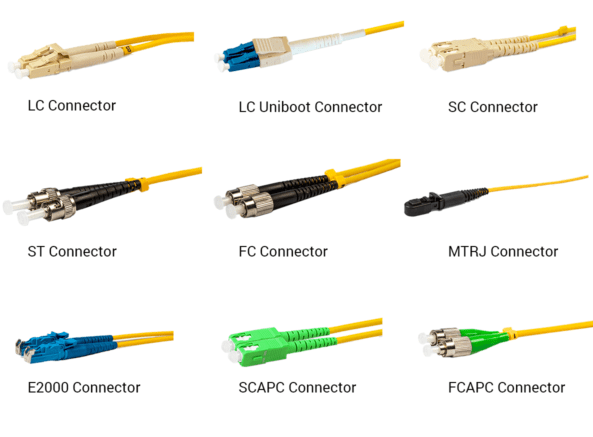
Connector Type Selection
Fiber optic patch cords come in various connector types, such as LC, SC, FC, ST, and MTP/MPO. Selection should be based on the interfaces of the two devices to be connected: if both devices have the same interface, choose a patch cord with connectors at both ends identical (e.g., LC-LC, SC-SC, FC-FC); if the interfaces are different, choose a hybrid patch cord with connectors at both ends different (e.g., LC-SC, LC-FC, LC-ST).
Endface Type Selection
Common endface types include APC (Angled Physical Contact) and UPC (Ultra-Physical Contact). APC has lower fiber loss and better optical performance than UPC, therefore it is widely used in FTTX, PON, and WDM optical equipment where return loss is more critical. However, APC is generally more expensive than UPC. Therefore, you should choose between APC and UPC based on your actual application needs and budget.
Selection Based on Fiber Optic Type
The fiber optic type of a patch cord determines its applicable data transmission distance; therefore, it must be selected based on the actual transmission distance requirements.
Single-mode fiber optic patch cords are primarily used for long-distance data transmission with minimal loss. Multimode fiber optic patch cords are mainly suitable for short-distance transmission, such as in indoor data centers and enterprise LANs where transmission distances are relatively short.
Selection Based on Other Specifications
In addition to the core factors mentioned above, the simplex/duplex type, length, and outer sheath material of the patch cord also need to be selected based on the specific application scenario.
Regarding simplex/duplex type: Simplex patch cords have one fiber optic cable and one connector at each end, supporting unidirectional data transmission; duplex patch cords have two fibers and two connectors at each end, supporting bidirectional data transmission, and are commonly used in duplex communication scenarios such as optical switches, servers, and optical modems.
Regarding length and outer sheath: Fiber optic patch cords are typically 0.5 meters to 100 meters in length; the appropriate length should be selected based on the distance between the devices to be connected. Outer sheath materials typically include PVC, LSZH, OFNP, and armored: PVC sheaths are inexpensive, flexible, and oxidation-resistant, making them suitable for horizontal and vertical cabling in enclosed, ventilated buildings; LSZH sheaths produce less smoke and are halogen-free, making them suitable for horizontally structured cabling areas; OFNP sheaths have the highest fire resistance rating and are suitable for large indoor data centers; armored sheaths are abrasion-resistant and interference-resistant, making them suitable for outdoor or harsh industrial environments.