This article provides a systematic introduction to DAC cables. It categorizes DACs by transmission rate and product type, detailing the differences between passive and active DACs in terms of performance, power consumption, and transmission distance, and listing applicable scenarios for different specifications. Let's learn together!
This article provides a systematic introduction to DAC cables. It categorizes DACs by transmission rate and product type, detailing the differences between passive and active DACs in terms of performance, power consumption, and transmission distance, and listing applicable scenarios for different specifications. Want to learn more? Contact us now!
DAC Cable Introduction
DAC (Direct-Connect Copper Cable) is currently the mainstream high-speed interconnect solution, suitable for short-distance transmission. It is widely used in data centers, server links, and storage device communication. DACs offer flexible specifications and stable performance, meeting diverse network needs, and are classified by transmission rate and product type.
DAC cable classification
DAC Classification by Transmission Rate
Multiple speed levels are available to meet diverse network architectures and application needs:
10G SFP+ / 25G SFP28 DAC: Suitable for basic interconnects of servers, switches, and storage devices.
40G / 50G QSFP+ & QSFP28 DAC: Suitable for short-range links and high-performance computing scenarios.
100G / 200G QSFP28 / QSFP56 DAC: Suitable for spine-leaf networks in large data centers.
400G QSFP-DD DAC: Optimized for AI computing clusters and high-density data center deployments.
Passive DACs vs. Active DACs
Based on their structural characteristics, DACs can be divided into passive and active types, each with its own advantages. Passive DACs require no external power supply and operate using the native signal from their ports. Their power consumption is less than 0.1W, offering high cost-effectiveness, and a transmission distance of 0.5 to 7 meters, making them ideal for short-distance connections within a rack. Active DACs employ built-in signal amplification and equalization circuitry to improve signal quality. They offer longer transmission distances, from 5 to 15 meters, and can adapt to complex cabling, although their power consumption is slightly higher, remaining below 1W.
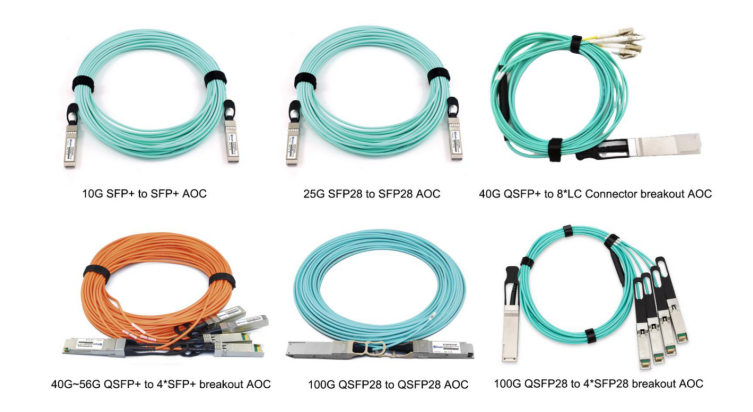
Typical Application Scenarios
In practical applications, passive DACs are an economical choice for short-distance links within a rack or between adjacent racks. Active DACs are suitable for ToR and EoR network layouts and can effectively solve signal attenuation problems in cross-channel and medium-distance cabling. Properly selecting the DAC type and length can effectively improve network stability in data centers and high-performance computing (HPC) systems.


