Against the backdrop of continuous upgrades in AI computing, cloud data centers, and enterprise-level storage, server systems are evolving towards higher bandwidth, higher density, and higher reliability. The Slim SAS (SFF-8654) interface has emerged in response to this trend and has become a widely adopted high-speed interconnect solution for next-generation servers.
Against the backdrop of continuous upgrades in AI computing, cloud data centers, and enterprise-level storage, server systems are evolving towards higher bandwidth, higher density, and higher reliability. The Slim SAS (SFF-8654) interface has emerged in response to this trend and has become a widely adopted high-speed interconnect solution for next-generation servers.
Overview
Slim SAS (
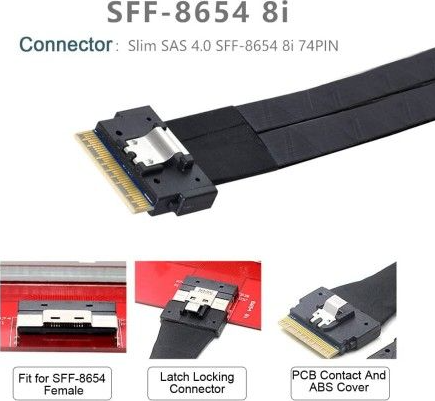
SFF-8654) is a high-density internal interconnect interface defined by the SFF standard, primarily used for connections between motherboards, HBA/RAID controllers, and storage backplanes. While maintaining high-speed data transfer capabilities, it significantly reduces the interface size, providing greater flexibility for internal system wiring and structural optimization.
Core advantages
Slim SAS (SFF-8654) is a high-density internal interconnect interface defined by the SFF standard, primarily used for connections between motherboards, HBA/RAID controllers, and storage backplanes. While maintaining high-speed data transfer capabilities, it significantly reduces the interface size, providing greater flexibility for internal system wiring and structural optimization.
High-speed data transmission
Supports SAS and PCIe interfaces, meeting the demands for high-bandwidth, low-latency storage access.
High-density design
The Slim SAS (SFF-8654) interface features a significantly smaller form factor compared to previous standards, which helps simplify internal cable routing, reduce space requirements, and improve airflow within the chassis, thereby enhancing overall cooling efficiency.
Excellent compatibility
It is compatible with various server platforms and supports enterprise-grade storage and NVMe architecture requirements.
Typical application scenarios
1.AI Servers and High-Performance Computing (HPC)
2.Enterprise-Grade Storage Systems
3.Cloud Data Centers and Hyperconverged Architecture