Fiber optic connectors are critical components used to link fiber optic cables with various types of equipment and assemblies. Among the diverse range of fiber optic connectors available, the LC fiber optic connector stands out due to its unique performance characteristics and widespread market adoption. This article provides a comprehensive overview of the LC fiber optic connector; let's explore its key features, as well as its advantages and disadvantages.
Fiber optic connectors are critical components used to link fiber optic cables with various types of equipment and assemblies. Among the diverse range of fiber optic connectors available, the LC fiber optic connector stands out due to its unique performance characteristics and widespread market adoption. This article provides a comprehensive overview of the LC fiber optic connector; let's explore its key features, as well as its advantages and disadvantages.
What Is an LC Fiber Optic Connector?
In the context of fiber optic connectors, the abbreviation "LC" stands for "Lucent Connector"—a term that literally translates to "light-transmitting" or "transparent" connector. As one of the smallest fiber optic connectors available on the market, it features a ferrule diameter of just 1.25 millimeters—approximately half the size of SC or FC connectors. Thanks to its compact design, the LC connector is classified as a "Small Form Factor" (SFF) connector—a category specifically engineered to conserve space.
LC connectors are primarily categorized into two types—simplex and duplex—each designed to meet specific connectivity requirements:
- Simplex Adapters: These adapters connect a single LC fiber optic connector within a single module slot, making them suitable for applications requiring only a single fiber connection (e.g., unidirectional signal transmission).
- Duplex Adapters: In contrast, duplex adapters connect two LC fiber optic connectors within a single module slot, making them an ideal choice for scenarios involving bidirectional signal transmission (e.g., the simultaneous sending and receiving of data).
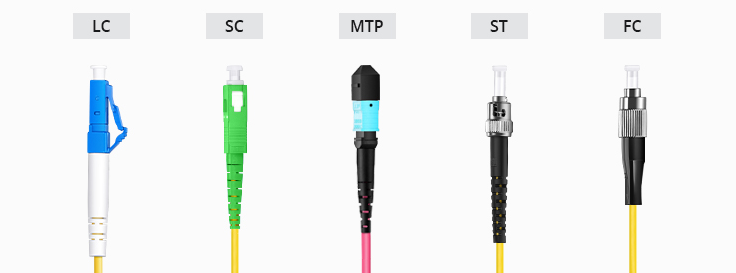
Key Advantages of LC Fiber Optic Connectors
Suitable for Confined Spaces
The miniaturized design of LC fiber optic connectors makes them particularly well-suited for environments with limited angles or confined spaces—such as inside optical modules (transceivers)—without occupying excessive room. This represents a significant advantage for modern electronic devices, where internal space is at a premium.
Interchangeability Between Simplex and Duplex Configurations
Another significant advantage of LC connectors lies in their compatibility with clips. By attaching a clip, a simplex LC connector can be easily converted into a duplex connector, thereby enhancing its flexibility and making it more adaptable to diverse application requirements.
Easy Installation and Secure Connection
The process of terminating an LC connector onto the end of a fiber optic cable is relatively straightforward, ensuring a tight and secure connection. It is resistant to accidental disconnection from the socket caused by inadvertent physical stress, thereby helping to maintain a stable and reliable connection status; this not only reduces labor costs but also significantly boosts operational efficiency.


