The relationship between "Ethernet cable" and "network cable" is similar to that between "car" and "vehicle." Although people often use the two interchangeably, Ethernet cable is actually just one type of network cable. Clarifying this concept is crucial for selecting the most suitable cable for a specific scenario.
While the terms are often used interchangeably, it's crucial to understand that "Ethernet cable" and "network cable" have a specific relationship. Essentially, Ethernet cable is a type of network cable, but not all network cables are Ethernet cables. The term "network cable" is a broad category that encompasses several cable types used for communication, including Ethernet cables, fiber optic cables, and coaxial cables.
Classifications
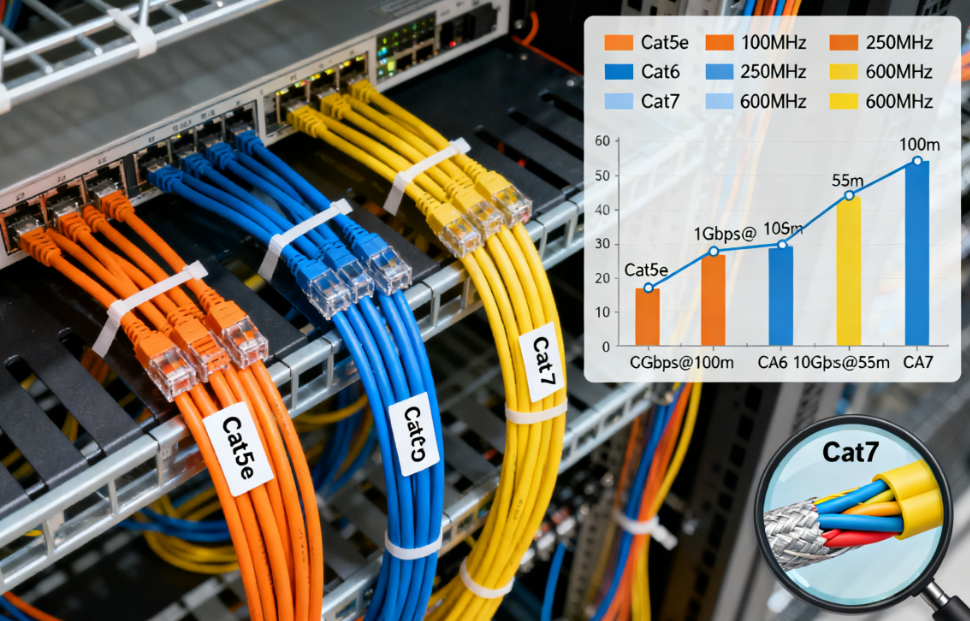
This difference is clear in how they are classified. Ethernet cables are categorized primarily by their performance standards, such as Cat5e, Cat6, Cat6a, and so on, with each category defining capabilities for speed and bandwidth. In contrast, other network cables are classified by different criteria; fiber optic cables, for instance, are distinguished by their core composition and transmission mode (single-mode or multi-mode), while coaxial cables are defined by their impedance and shielding.
Applications
Their applications also highlight this distinction. Ethernet cables are the workhorses of Local Area Networks (LANs), perfect for connecting devices like computers, printers, and switches within a home, office, or data center. Other network cables serve broader purposes. Fiber optic cables, with their high speed and low latency, form the backbone for long-distance connections in Metropolitan or Wide Area Networks (MANs/WANs), and coaxial cables are most familiar for delivering cable television and broadband internet services to residences.
Characteristics
Speed
Transmission speeds vary significantly among different network cables. Ethernet cable speeds depend on their category, ranging from 1 Gbps for Cat5e to 10 Gbps for Cat6/Cat6a/Cat7. In contrast, fiber optic cables offer speeds far exceeding Ethernet, reaching over 100 Gbps, while coaxial cables typically have a maximum speed of 1 Gbps.
Range
The effective transmission distance varies significantly across different cable types. Ethernet cables are typically limited to a maximum range of 100 meters before signal degradation necessitates the use of repeaters or switches. In stark contrast, fiber optic cables can carry data over several kilometers with minimal signal loss, making them the superior choice for long-distance applications like connecting buildings or establishing network backbones. Coaxial cables offer a moderate range that adequately serves most residential and small-scale commercial installations.
Connectors
Finally, their physical construction and connectors are distinct. Ethernet cables are made from twisted pairs of copper wires and use the ubiquitous RJ45 connector. Fiber optic cables transmit data as light pulses through glass or plastic fibers and use a variety of connectors like LC, SC, or ST. Coaxial cables, with a central copper conductor surrounded by shielding, typically use F-type or BNC connectors for their specific applications.


