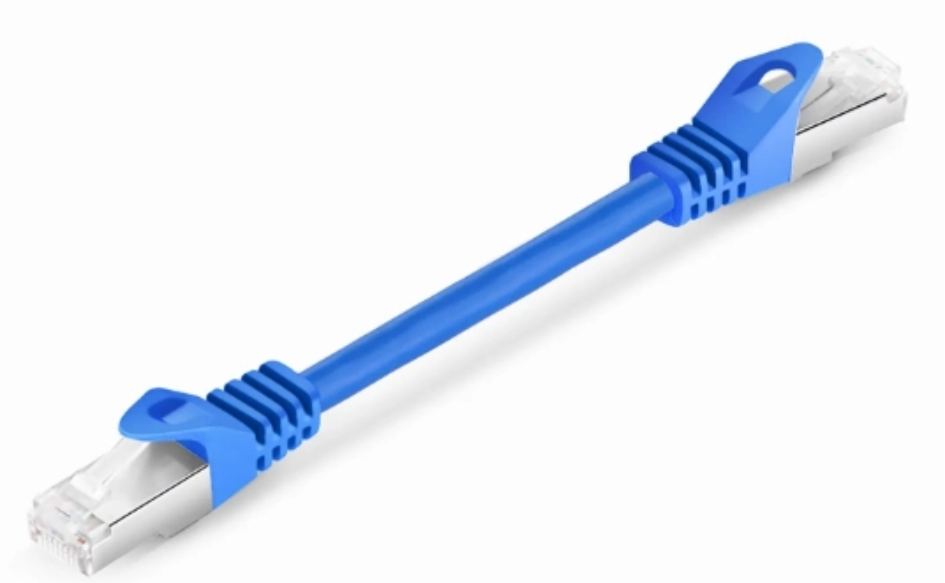
The SC is a mainstream fiber optic connector featuring a rectangular bayonet design for easy insertion, removal, and positioning. It supports single-mode and multimode fibers with wavelengths of 1310nm and 1550nm, and depending on the specific module configuration, transmission distances can range from 20km to 120km.
Applicable: Building fiber optic network access, video surveillance fiber optic extension, industrial automation networks, simple point-to-point fiber optic transmission.
Advantages: High cost-effectiveness, easy installation, and low maintenance difficulty.
Disadvantages: Fixed interfaces, low flexibility; does not support hot-swapping.
The ST type fiber optic connector is a classic metal bayonet-style fiber optic connector with a circular rotary locking structure. It is primarily used for multimode fiber, but is also compatible with single-mode fiber, and is suitable for short- to medium-distance transmission at wavelengths of 850nm and 1310nm.
Applicable: Campus LANs, industrial control networks, and upgrades to traditional fiber optic systems.
Advantages: Ultra-stable interface, strong shock resistance; high plug-in/plug-out cycle count, long service life.
Disadvantages: Market acceptance is gradually declining; lower adoption rate compared to SC interfaces.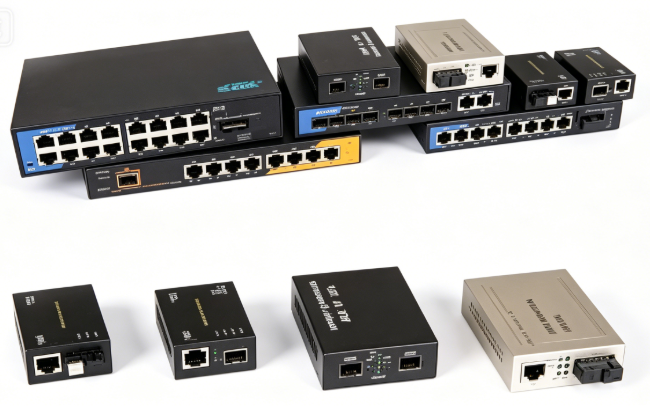
SFP, or Mini-GBIC, features a modular slot design with interchangeable optical modules. It supports single-mode and multimode fiber, multiple wavelengths including CWDM/DWDM, gigabit and 10-gigabit network transmission distances of 550 meters to 120 kilometers, and supports hot-swapping for flexible field deployment.
Applicable ScenariosData center fiber access, enterprise park backbone network, telecom operator access network, high-speed network reconstruction and upgrade.
AdvantagesHigh flexibility to swap SFP modules freely; compatible with multiple rates and transmission distances; convenient for later maintenance and network upgrade.
DisadvantagesHigher overall cost than SC/ST fixed interface converters.